Illustrated sample project guide
Harbor Point: From Rough Need to Comparable Contractor Proposals
Follow an exterior repair and repainting project from the first description to a conditional contractor recommendation. Learn what to enter, why the questions matter, and what still needs checking before work can begin. Harbor Point, its contractors, and its proposals are fictional demonstration materials. The example ends with a provisional recommendation and open questions. It does not document a real contract award, completed project, or verified savings.
By Tim DeNardo, Founder of Scope-to-Go · Published · Updated · Educational resource1. Describe the job and the result you need
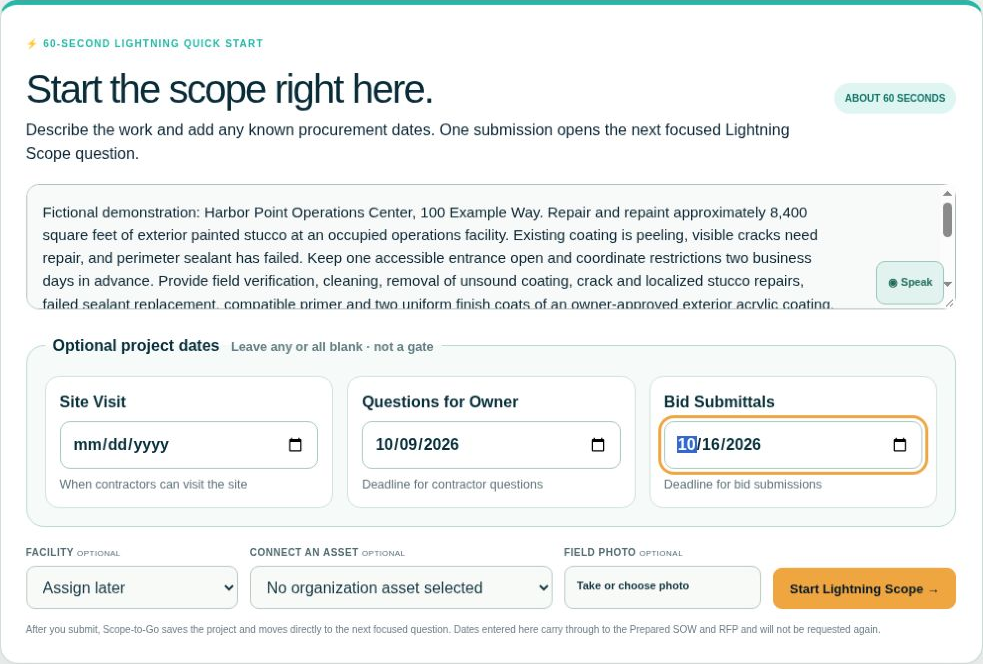
Start in Lightning Quick Start with a plain-language description. You do not need a finished specification to begin.
Harbor Point needs repair and repainting of approximately 8,400 square feet of painted stucco. The coating is peeling, visible cracks need repair, and perimeter sealant has failed. The facility must stay occupied during the work.
- Describe the location, visible conditions, approximate size, and desired result.
- Add operating limits, such as keeping an accessible entrance open and coordinating restrictions in advance.
- Enter known dates. In this example, the required completion period is 45 calendar days after notice to proceed.
Why it matters: a clear starting brief helps contractors understand the same job, including the work around the painting.
2. Answer the questions that change the scope
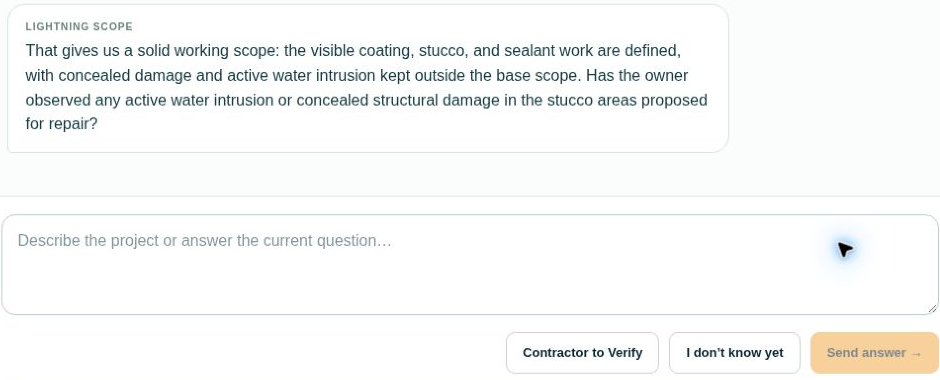
Work through the focused questions. Give the facts you know, and identify anything that needs field verification.
For Harbor Point, questions about water intrusion and concealed damage help distinguish visible repairs from conditions that may require a separate assessment. Questions about access, coating requirements, and warranties help define responsibilities before bids arrive.
- Conditions: what has been observed, and what must a qualified contractor or specialist verify?
- Operations: which entrances, hours, and work areas must stay available?
- Materials and acceptance: what finish is required, and how will the owner review the finished work?
If an answer is unknown, use “I don't know yet” or “Contractor to Verify” where appropriate. Keep uncertainty visible rather than guessing.
3. Review the scope and prepare the RFP
Generate the draft statement of work, or SOW, then review it before preparing the request for proposals, or RFP.
The SOW explains the work and the expected result. The RFP tells contractors what to submit, when to respond, and how proposals will be considered. Review the wording and any flagged issues, and make sure both documents give consistent instructions.
- Check that preparation, visible repairs, sealant, coating, access protection, cleanup, and closeout are covered.
- Ask for complete pricing, duration, warranty terms, exclusions, and clearly identified alternates.
- Confirm dates, submission instructions, and responsibilities before issuing the package.
Why it matters: bids are easier to compare when every contractor is responding to the same requirements. The owner reviews and controls the final scope.
4. Review each proposal and clarify the gaps
Bring proposals into the project and check the recorded information against the original documents.
Review the price, scope, schedule, warranty, exclusions, and alternates. A successfully uploaded proposal still needs checking. When a term is incomplete or unclear, prepare a specific question and retain the response with the proposal.
- Gulfside: confirm sealant coverage, firm lift and access costs, and permit responsibility.
- Coastal: confirm quantities, taxes and permits, warranty coverage, and a complete signed offer.
- Panhandle: confirm how its elastomeric coating compares with the required acrylic base scope.
- All bidders: confirm current offer validity and how work will be phased around occupied entrances.
A prepared clarification is still an open question until a response is received and checked. The clarification drafts in this example remain unsent.
5. Why the lowest bid can cost more
Read the price together with what it includes. Keep unpriced required work visible in the comparison.
Gulfside has the lowest base bid at $52,400. Its $8,600 sealant alternate brings the known subtotal to $61,000 before unresolved lift, access, and permit costs. That subtotal is not a complete comparable cost.
Coastal's $58,900 base proposal states that sealant and access are included. Panhandle's $64,500 base includes an elastomeric coating, so the material basis needs clarification. Complete comparable costs remain unknown for all three offers.
Coastal remains the provisional candidate in this example, subject to clarifications and further value review. Record the reasons, the evidence, and the open conditions. Revisit the recommendation if verified answers change the comparison.
- Compare the same required work, including necessary additions to the base price.
- Review warranty coverage, maintenance needs, expected service life, and disruption where evidence is available.
- Leave unknown costs unknown. A longer warranty or lower base price alone does not establish long-term savings.
$52,400 base + $8,600 sealant = $61,000 known subtotal, plus unresolved costs. This example does not establish verified savings.

6. Keep the decision record clear
This is the next stage for a real project. It was not completed in the Harbor Point demonstration.
Before an award, resolve the required scope and cost questions, check contractor qualifications and insurance, confirm the schedule and contract terms, and obtain the appropriate budget and owner approval. A recommendation does not authorize work.
After an authorized start, coordinate access and inspections, resolve the punch list, and collect product records, warranties, maintenance information, and final photos. Record completion only when the work and required closeout are actually complete.
- Keep the decision record clear enough for someone new to the project to understand.
- Support changes, approvals, and completion with the actual evidence.
- Use the same basic flow for your project, with requirements suited to its conditions and your organization's process.
The useful outcome is a reviewable scope, a clearer proposal comparison, and a documented next decision. Harbor Point ends before award, start, or completion.
Templates and assistant-generated content are starting points, not engineering, legal, code, safety, procurement, or financial advice. A qualified person must review project-specific requirements before issue or award.